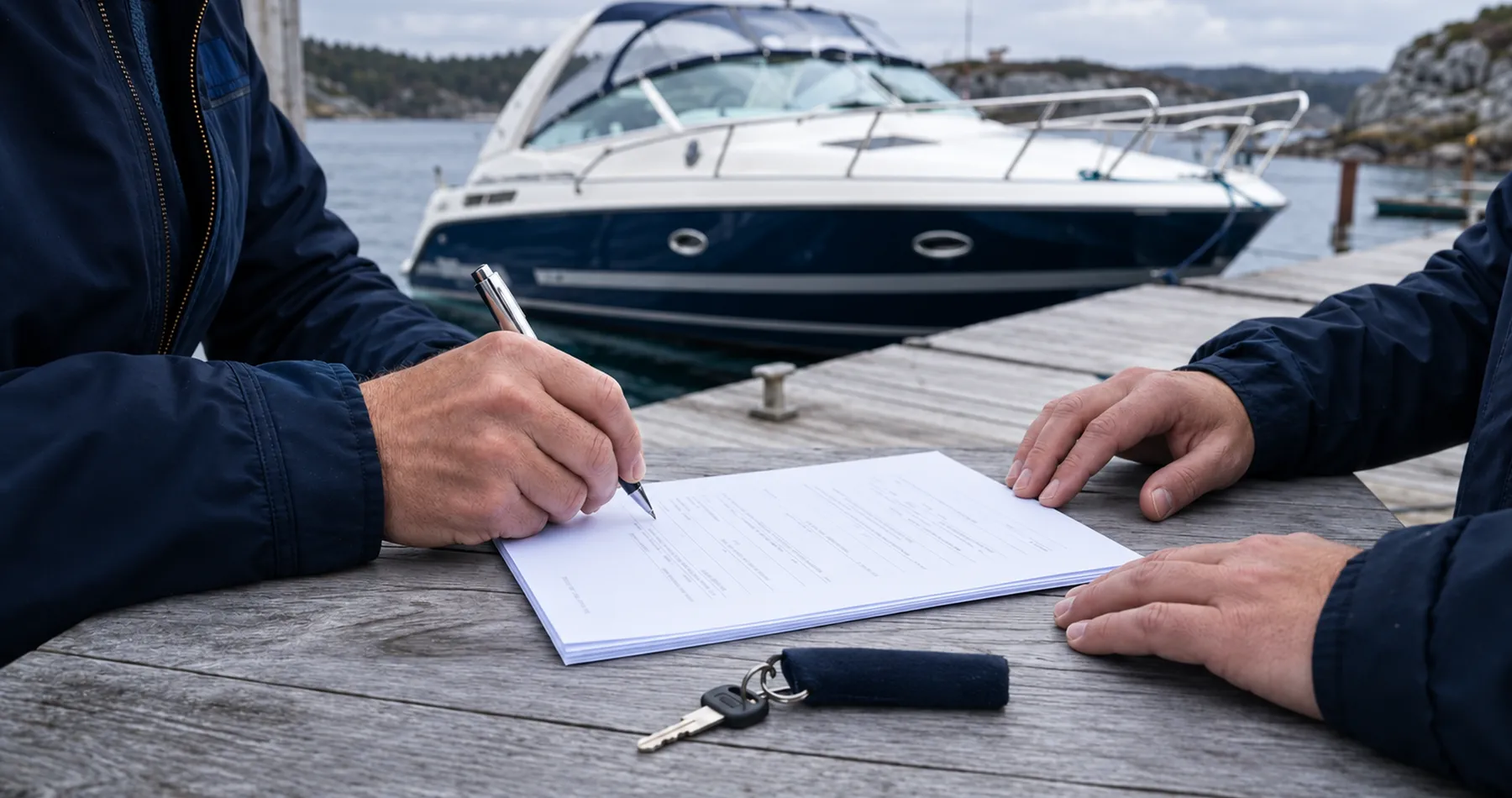
Why put a boat sale in writing?
A boat changes hands with real money, an engine that has a history and equipment that is easy to miscount. A one-page written agreement removes most later arguments: it fixes who sold what, to whom, for how much and in what condition. It also gives the new owner the paper trail needed to register the boat or insure it in their name.
What a boat sale contract should cover
- Full names and contact details of seller and buyer.
- The boat: make, model, year, length and the identification details you have, such as a hull number.
- The engine — make, power and hours — and the trailer, if they are part of the sale.
- A simple inventory of included equipment: electronics, covers, safety gear, keys.
- The price, the payment method and the payment date.
- The boat's condition as described, with known faults written down.
- Date, place and both signatures — one copy for each side.
Listing known faults in the contract is not a weakness. A fault written down and accepted at signing is very hard to dispute later; a fault "discovered" after handover is where conflicts start.
"Sold as seen" — and its limits
Used boats are normally sold in the condition they are in, and the contract should say so. An as-seen clause protects the seller against ordinary wear and against faults the buyer inspected or was told about. It does not cover a defect the seller knew about and kept quiet — a clause does not turn a concealed fault into an accepted one. The practical conclusion is the same as above: the more honest the description, the stronger the clause. Write down the hours, the winters ashore, the repairs you know of and the ones you suspect.
If the buyer wants a survey or a sea trial before signing, agree in writing who pays for lifting and who carries the risk during the trial. A short line in the contract is enough.
The documents that support the sale
- Proof of ownership — the contract or invoice from when you bought the boat.
- Registration papers, if the boat is listed in a register.
- Service records and receipts for major work.
- Owner's manuals and any CE documentation that came with the boat.
- All sets of keys.
Missing some of these is common, especially with older boats. It rarely blocks a sale on its own — say what you have and what is lost, and let the paperwork you do have carry the story. Hiding a gap is what creates distrust.
Why do buyers care so much about old papers? Because they prove the ownership chain. A boat with a previous contract, service receipts and matching identification numbers is easy to trust and easy to insure; a boat with no history at all makes a careful buyer walk away even when the price is right. Every document you find raises the boat above the ones sold without any.
Ownership transfer and registration
What happens after signing depends on where the boat is registered. If it sits in a national or voluntary register, the owner change should be reported promptly so the boat stops being your responsibility on paper. If the boat is not registered anywhere, the signed contract itself becomes the ownership document — one more reason to write it properly.
Do not leave the report "for later". As long as a register still names you as the owner, letters about mooring fees, an abandoned trailer or an incident on the water come to you first, and untangling that months after handover takes far more effort than a form filed the same week. The buyer has their own list: registering in their name, insuring the boat and, in some countries, notifying the harbour or marina. Agree at handover who files what, and put the split in the contract.
End or transfer your insurance from the handover date — not the day the ad went up, and not "when I get to it". Keep your copy of the contract for several years; it is your proof of the date the boat, and the responsibility, changed hands.
A loan on the boat
An outstanding loan does not prevent a sale, but it must be part of the plan, not a surprise. Tell the buyer early and ask your lender what they need to release the boat — banks answer this question every week and usually have a standard procedure.
In practice the loan is settled in one of three ways: paid off before the sale, paid directly to the lender out of the purchase price at handover, or handled by the buyer's own bank as part of their financing. Which route fits depends on the lender; what matters in the contract is that the route is written down, with the amount going to the lender and the amount going to you. Keep the loan specifics out of open channels — they belong in a direct conversation, not in a public listing.
Payment and handover
Use a traceable payment method and agree the timing in the contract: what is paid, when, and what happens at handover. Hand over the boat, the keys and the documents at the same moment the payment completes — not before. Both sides should leave the handover with a signed contract and nothing still owed.
The mistakes that cause most trouble are all avoidable:
- Keys or the boat handed over "for the weekend" before the payment has cleared.
- A deposit taken with no written terms — is it refundable, and until when?
- Part-payments agreed verbally, with no schedule in the contract.
- A price changed by phone after signing, with nothing added to the paper.
- Equipment removed after the photos were taken, without updating the inventory.
None of these need more than a sentence in the contract to prevent.
Selling for someone else or from an estate
If the boat belongs to a relative, an estate or several owners together, the sale needs the owners' consent in writing — a short authorization is usually enough. The rest of the process is the same; it just starts with one extra paper. If the situation is unclear, describe it as it is and resolve the missing piece before signing, not after.
With an estate, check who is entitled to sign for it before agreeing a price — in most countries that is settled by the estate paperwork, not by who has the keys. Selling first and sorting the authority afterwards is the one order that reliably goes wrong.
Engines, jet skis and trailers: what changes
The contract, the honest description and the payment rules are the same whatever you are selling. What differs is the paper trail behind the item:
- An engine sold on its own normally sits in no register at all. The serial number takes the place of a hull number, so photograph it and write it into the contract along with the model and year. Receipts and service records carry most of the weight here.
- A jet ski is treated like a small boat in some countries and like a registered craft in others. If yours is registered, report the owner change as you would for a boat; if it is not, the contract is the ownership document. The trailer it stands on is usually part of the same deal — list it separately.
- A boat trailer is a road vehicle. Ownership passes through the road authority, not the boat register, and the plates, permitted weight and any inspection status belong in the contract.
Selling to BoatsHaven instead
When you sell directly to us, this whole chapter gets shorter: we prepare the sale contract and transfer documents, arrange secure payment and coordinate collection. You describe the boat, jet ski or engine and send the documents you have — we clarify the rest step by step.