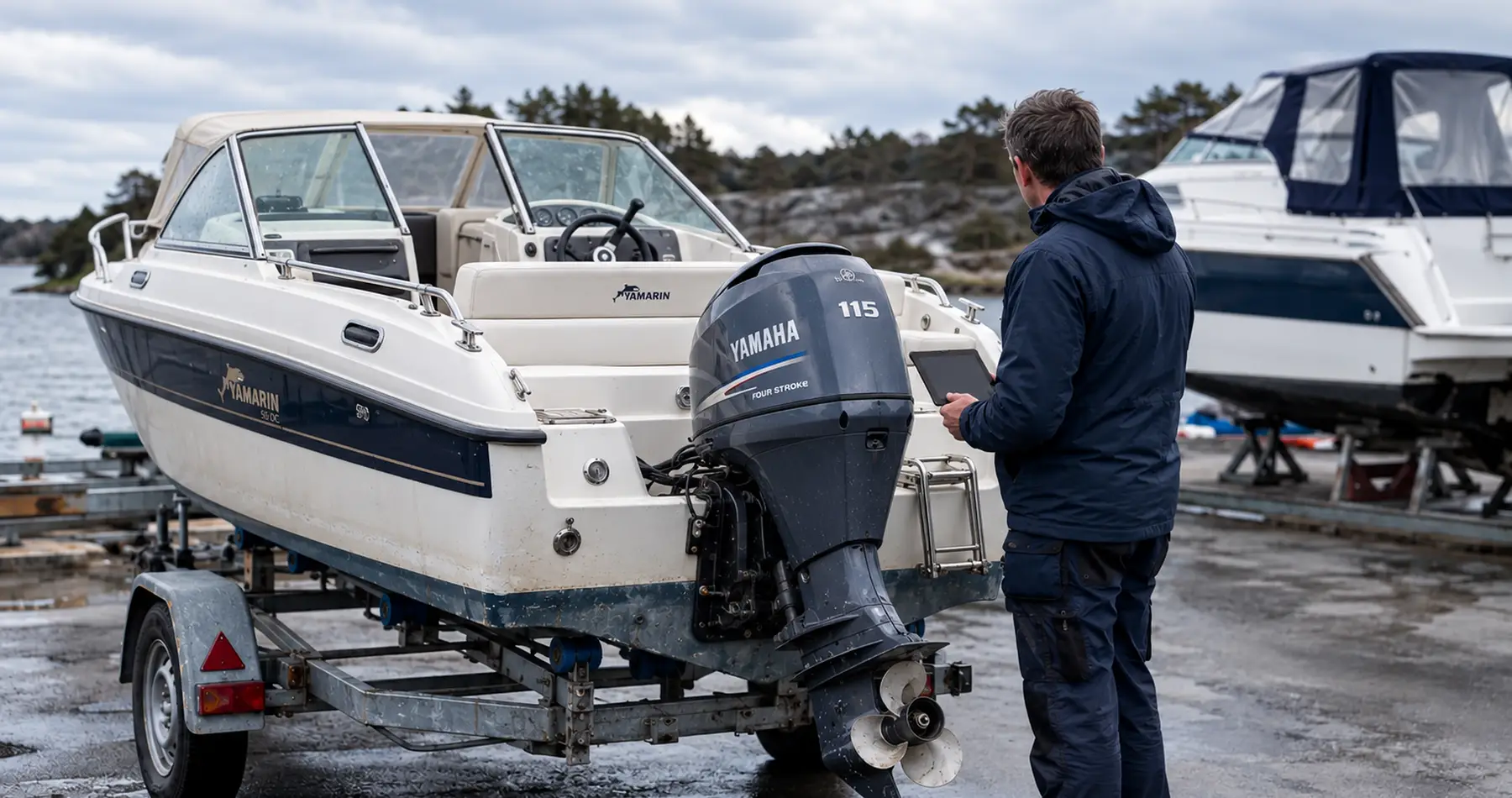
Model and year set the range — nothing more
Every used boat starts from a rough range: what boats of that type, size and age generally change hands for. That range is wide, and where a particular boat lands inside it is decided by everything else on this page. This is why a valuation cannot be read off a table — the table only tells you the range.
Two boats built the same year, one kept under cover with a full service history and one that spent six winters in the open with an unknown engine, are not competing for the same buyer at all.
What raises the value
- Engine condition and hours. On most motorboats the engine is the single largest part of the value. A running, serviced engine with documented hours is worth far more than a stronger hull with a doubtful engine.
- Documentation. Service records, receipts for major work, manuals and a clear ownership history all reduce a buyer’s risk — and a buyer who feels less risk pays more.
- Storage and use. Freshwater use, winter storage ashore or under cover, and a boat that has actually been run each season all show in the survey and in the price.
- A complete package. A usable trailer, working electronics, covers and safety equipment make the boat ready to use rather than a project to finish.
- Presentation. Cleaned, emptied and honestly photographed. It changes nothing mechanically and still moves the price, because it changes what the buyer believes about the care the boat has had.
Buyers of used boats pay for confidence, not for a features list. Anything that lets someone check a claim — a receipt, a photo of the serial plate, an engine that starts on the first attempt — is worth more than another line in the description.
What lowers it
- An engine that will not start, or one with an unclear repair history. This is the biggest single deduction on most boats.
- Water in the hull, soft floors or a suspect transom. Structural doubt is expensive because the cost of fixing it is unknown until the work starts.
- Missing documents. Not fatal, but it narrows the number of buyers willing to proceed.
- Osmosis, long standing damp, rot in wooden parts. Slow problems that are hard to price and easy to fear.
- Unfinished projects. A half-completed refit is usually worth less than the same boat untouched — the next owner has to undo decisions they did not make.
- Outdated or dead electronics. They rarely add value; they only remove the objection.
Season and timing
Boats are seasonal goods. Demand is strongest before and at the start of the season, when buyers are planning to use the boat that same summer. As autumn approaches, the same boat competes for far fewer buyers, and the ones who are looking know it — which is exactly when prices soften. A boat that also needs winter storage adds a cost to the equation for both sides.
Timing does not change what a boat is; it changes how many people want it this month. If you have the option to choose when to sell, that choice is worth more than most cosmetic work.
Does a repair before selling pay for itself?
Sometimes, and less often than owners expect. A useful test: will the repair remove a buyer’s doubt, and will it cost clearly less than the value it unlocks?
- Usually worth doing: small, cheap fixes that stop a buyer from walking away — a service, a battery, a light, a clean.
- Rarely worth doing: a major engine rebuild or structural work on an older boat. The market seldom returns the full cost, and you carry the risk of the work overrunning.
- Almost never worth doing: starting a project you may not finish before you sell.
Selling as it is, honestly described, is a legitimate strategy. Many buyers — including us — would rather price a known fault than pay for a repair they cannot verify.
Trailers, engines and jet skis
The same logic applies with different weights. On an outboard engine sold on its own, hours, compression and service history are nearly everything, and the serial number makes the history checkable. On a jet ski, hours are low and condition is visual — storage and whether it has been flushed after salt water matter more than age. A road-legal trailer with a valid inspection holds its value better than most boat equipment, because it is useful to almost every buyer.
When a boat has stopped being worth restoring
Some boats reach a point where the honest answer is that no repair returns its cost. The signs are consistent: structural damp or rot, an engine beyond economic repair, a hull that needs more work than the finished boat would be worth, and a model nobody is looking for. Owners often carry such a boat for years because a decision feels like a loss — while storage, insurance and the falling value quietly cost more than the decision would have.
Even then the boat is rarely worth nothing. The engine, the trailer, the electronics and usable equipment have their own value, and a complete boat is worth more than the parts stripped from it. The order that works is: find out what it is worth as it stands, then decide. Reversing that order — scrapping first, asking later — is what loses money.
The cost of standing still
An unused boat is not a neutral asset. Every season it costs a berth or storage, insurance, and the maintenance needed to stop condition from sliding. Meanwhile the value moves in one direction. A boat used three weekends a year and a boat not used at all cost nearly the same to keep, and after two or three years that total is a real share of what many older boats are worth.
This is why "I will decide next season" is itself a decision with a price. Knowing the current figure at least makes it a choice rather than a drift.
How to get a realistic figure
Look at what comparable boats are actually being sold for, not what they are advertised at — asking prices include hope. Compare boats of similar age, engine and condition, and discount for anything yours is missing. Then decide what matters more to you: the highest possible number, or the shortest, most certain route.
A free review from us gives you the second one: send photos, model, year and honest notes on the condition, and you get a concrete figure to compare against — with no obligation, and nothing to pay either way. If the boat is not worth restoring at all, it is worth reading about scrappage and disposal before deciding.