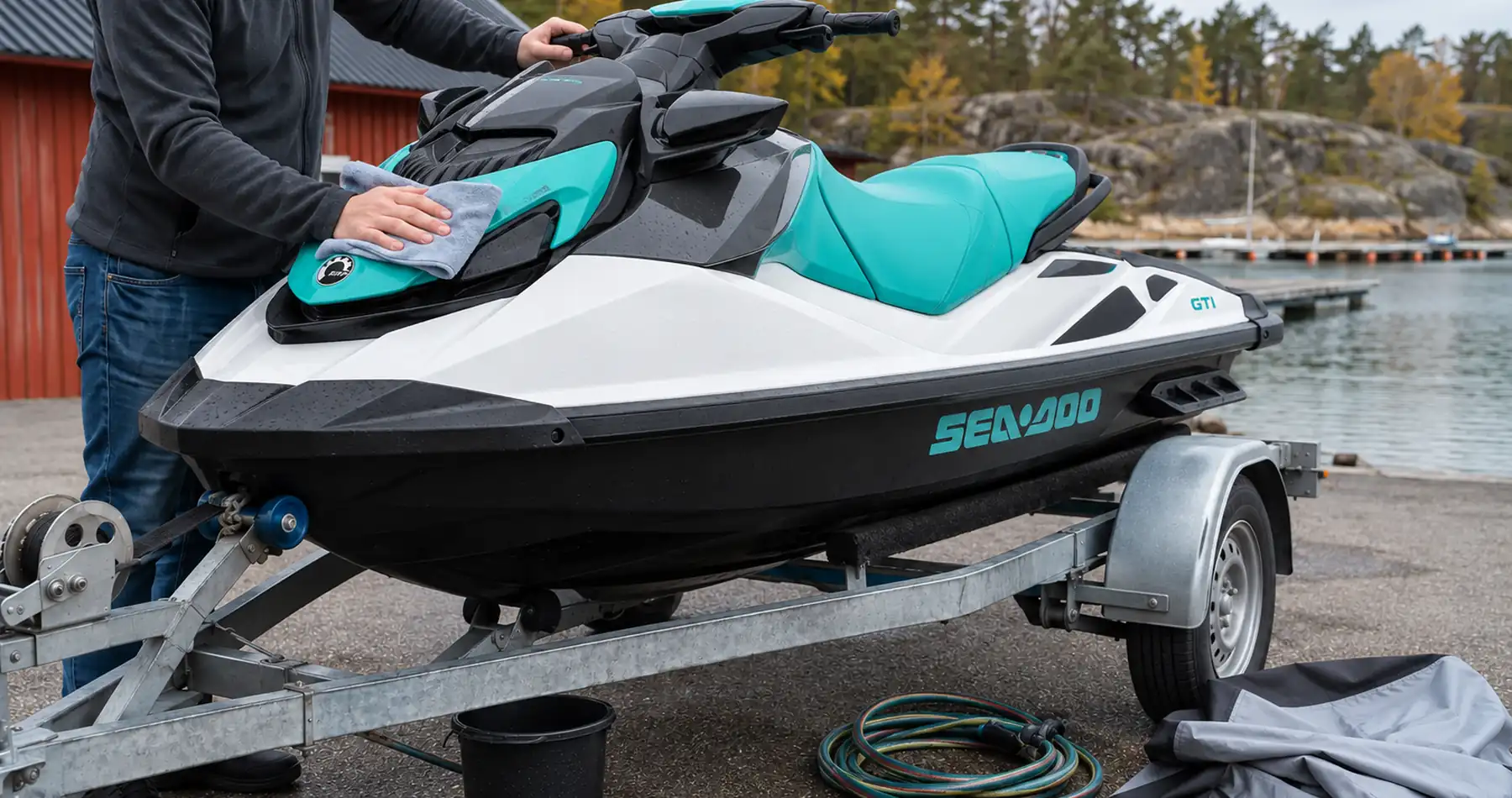
What storage actually costs
The storage fee is the visible part. Around it sit the things that repeat every year: winterisation or the work to do it yourself, a battery that will not survive being left flat, fuel treatment, insurance while the ski sits still, and the annual service that keeps a stored ski from becoming a repair project.
None of it is dramatic on its own. Over two or three unused seasons it adds up to a real share of what many older skis are worth — which is why the honest question is not "how do I store it" but "is another season worth it".
If you are keeping it: do the storage properly
Follow the manufacturer's procedure for your model — the details differ between two-stroke and four-stroke, and between supercharged and naturally aspirated skis. The general shape is the same:
- Flush and dry. Flush the cooling system, especially after salt water, and let everything dry before covering.
- Clean and inspect. Hull, pump, intake grate, seals and hose clamps. Note damage now, not in spring.
- Fuel and oil. Stabilise the fuel, change the oil where the manual calls for it, fog the engine if specified.
- Battery out. Removed, charged and kept somewhere frost-free.
- Cover, not seal. A breathable cover; trapped damp does more harm than cold.
- The trailer too. Tyres, bearings, lights and a lock — and check the inspection date before you tow it again.
Most problems on stored skis are not caused by use. They come from stale fuel, flat batteries, damp under a plastic sheet and seals that dry out. A ski used every season is usually in better condition than one that has sat for three.
Where the ski is stored matters
Indoor, dry and frost-free is best and costs most. A garage is usually fine. Outdoors under a tarpaulin is the worst of the options: condensation collects under the sheet, seals dry and crack in the sun, and the ski becomes an easy target for theft. If outdoors is the only choice, use a breathable cover, raise the ski off the ground and lock it to the trailer.
Storage away from home has its own cost: every check, every service and every decision now involves a drive. Skis that end up forgotten are almost always skis stored somewhere inconvenient.
Before using it again
Refit the charged battery, check the fuel, inspect the impeller and intake, look over the hoses and clamps, and run the engine before you plan a long trip. Check the trailer's tyres and lights on the driveway rather than on the motorway.
Judging another season against the value
Jet ski values hold up reasonably well when hours are low and the ski has been looked after. They fall fastest when a ski sits unused: hours stay flat while condition, batteries and seals quietly get worse, and a ski that has not run for two winters is a harder sell than one that ran last summer.
Three questions usually settle it. How many times did you actually use it last season? What did that season cost, storage and service included? And what would the ski be worth if you sold it now, rather than after another winter?
There is no shame in either answer. Plenty of owners store a ski for a season because life is busy and come back to it happily. The mistake is drifting — paying for storage year after year for something you have quietly stopped using, while its value falls in the background.
If the answer is to sell
BoatsHaven buys jet skis of many makes and model years, including skis that will not start and skis sold with their trailer. It is worth knowing what shapes the value before you decide, and getting a free offer costs nothing either way.